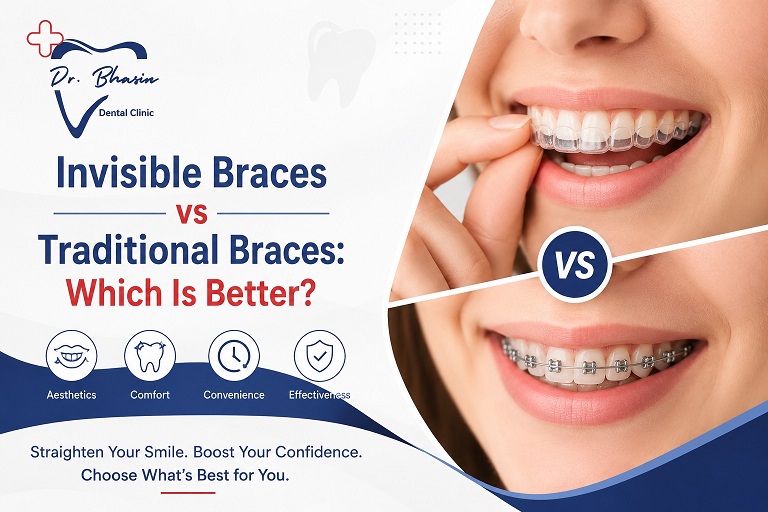
A straight and confident smile can improve both your appearance and oral health. Today, many people in India are choosing orthodontic treatments to correct crooked teeth, spacing issues, and bite problems. However, one common question patients often ask is — Should I choose Invisible Braces or Traditional Braces?
Both treatments are effective, but the right option depends on your dental condition, lifestyle, budget, and treatment goals. In this blog, we will compare Invisible Braces vs Traditional Braces in detail to help you make the best decision for your smile.
Understanding Traditional Braces
Traditional braces use metal brackets and wires attached to the teeth to gradually move them into the correct position. They have been used for decades and remain one of the most effective orthodontic treatments.
Common Features of Traditional Braces
- Metal brackets fixed on teeth
- Connected with orthodontic wires
- Regular tightening by the dentist
- Suitable for complex dental cases
Traditional braces are highly effective for severe alignment and bite correction issues.
What Are Invisible Braces?
Invisible braces, also known as clear aligners, are transparent removable trays designed to straighten teeth gradually. They are custom-made according to your teeth structure and are almost invisible while wearing them.
Key Features of Invisible Braces
- Transparent and removable
- Comfortable to wear
- No metal wires or brackets
- Easy to clean and maintain
- Popular among adults and working professionals
Invisible braces are becoming increasingly popular because they offer a more aesthetic orthodontic solution.
Invisible Braces vs Traditional Braces
1. Appearance and Aesthetics
Invisible Braces
Invisible braces are nearly invisible, making them ideal for people who want discreet orthodontic treatment.
Traditional Braces
Metal braces are clearly visible when talking or smiling.
Winner:
Invisible Braces
2. Comfort Level
Invisible Braces
Smooth plastic aligners reduce irritation and mouth ulcers.
Traditional Braces
Metal wires and brackets may cause discomfort, especially after adjustments.
Winner:
Invisible Braces
3. Treatment Effectiveness
Invisible Braces
Best for mild to moderate alignment problems.
Traditional Braces
More effective for severe crowding, complex bite issues, and major tooth movements.
Winner:
Traditional Braces
4. Eating Restrictions
Invisible Braces
You can remove aligners while eating, allowing you to enjoy most foods.
Traditional Braces
Sticky, hard, and crunchy foods are usually restricted to prevent bracket damage.
Winner:
Invisible Braces
5. Oral Hygiene Maintenance
Invisible Braces
Easy brushing and flossing because aligners are removable.
Traditional Braces
Cleaning around brackets and wires can be difficult.
Winner:
Invisible Braces
6. Treatment Time
The treatment duration depends on the complexity of the case.
- Invisible Braces: Usually 6–18 months
- Traditional Braces: Usually 12–24 months
In some complex cases, traditional braces may work faster and more efficiently.
7. Cost Comparison
Invisible braces are generally more expensive because of advanced digital planning and customized aligners.
Traditional braces are usually more affordable and widely accessible.
Winner:
Traditional Braces (Budget-Friendly)
Who Should Choose Invisible Braces?
Invisible braces are ideal for:
- Adults and professionals
- College students
- People concerned about appearance
- Mild to moderate alignment problems
- Patients wanting comfortable treatment
Who Should Choose Traditional Braces?
Traditional braces are suitable for:
- Teenagers
- Severe crowding or bite issues
- Complex orthodontic corrections
- Patients looking for affordable treatment
Are Invisible Braces as Effective as Traditional Braces?
Yes, invisible braces can be highly effective for many patients. However, traditional braces still remain the preferred option for complicated orthodontic cases.
A dental consultation is necessary to determine which treatment is best for your specific teeth condition.
Tips to Maintain Braces Properly
Regardless of the type of braces you choose:
- Brush twice daily
- Floss regularly
- Avoid excessive sugary foods
- Visit your orthodontist regularly
- Follow all treatment instructions carefully
Proper oral hygiene helps achieve faster and better results.
Final Verdict: Which Is Better?
There is no one-size-fits-all answer.
- Choose Invisible Braces if you want comfort, aesthetics, and flexibility.
- Choose Traditional Braces if you need complex correction and a cost-effective solution.
The best treatment depends on your dental condition, lifestyle, and orthodontic goals.
Get Expert Orthodontic Treatment at Dr. Damini Bhasin Dental Clinic
If you are confused between Invisible Braces and Traditional Braces, professional guidance can help you make the right decision.
At, Dr. Damini Bhasin Dental Clinic patients receive personalized orthodontic care using modern dental technology and advanced treatment methods. The clinic offers both Invisible Braces and Traditional Braces solutions tailored to individual smile goals and dental needs.
Whether you want a discreet smile correction option or comprehensive orthodontic treatment,
Dr. Damini Bhasin Dental Clinic provides expert care focused on comfort, aesthetics, and long-term oral health.